"Go into the arts. I'm not kidding. The arts are not a way to make a living. They are a very human way of making life more bearable. Practicing an art, no matter how well or badly, is a way to make your soul grow, for heaven's sake. Sing in the shower. Dance to the radio. Tell stories. Write a poem to a friend, even a lousy poem. Do it as well as you possibly can. You will get an enormous reward. You will have created something." Kurt Vonnegut
Tuesday, 10 February 2015
Bloomberg New Contemporaries 2015
I have just completed my entry for Bloomberg New Contemporaries 2015, submitting my digital art and animations this year, so it will be interesting to see how they contend. Here's hoping I get selected two years in a row!
Tuesday, 23 December 2014
AdamWallace.Art
This blog is no longer being updated regularly. If you want to follow my practice, and see more examples of my work, please visit the Adam Wallace Art site. Look forward to seeing you there, and at future shows which I plan to be part of.
Sunday, 18 May 2014
Nicola Samori
Interesting artist working across multiple media types, including collage, [which is what originally led me to him]. Can't help but wonder if its his work being appropriated by the Chapman brothers

"makes seductive, profound paintings by layering and fusing images on canvas, wood or copper and then obliterating them by scratching, erasing, fingering and painting over the surfaces multiple times. By violating the golden rule of all museums (“Please do not touch the artwork.”) Samorìis making art history by corrupting his own work and imposing a new Samorì on top. The resulting layers of paint create a new skin that bears the bruises and permanent marks of all prior creative efforts.
Selecting portraits and still life’s from classical paintings but also sourcing random faces and images from the Web, Samorì is engaged in a project about time and corrosion." http://beautifuldecay.com/category/collage/page/26/
| Leibl, 2011, oil on wood, 27 x 19 cm |
| Carmine,
2007/2008, mixed technique on paper applied on canvas, 230 x 150 cm
|
installation view |
Il vizio della Croce, 2014, Aurora Onyx, steel, 81 x 34 x 31,5 cm (detail) |
| exhibition view |
MRI Scans of Fruit and Veg
Came across this while looking for animation artists whose work might be inspiring for my own. They are images of fruit & vegetables placed in an MRI scanner, taken by British MRI technician Andy Elison. He discovered their surreal yet somewhat disturbing beauty after scanning an orange to calibrate the machine. Thereafter he began bringing produce to work and scanning it & posting the images on his blog http://insideinsides.blogspot.co.uk/
"The high-resolution black and white sequences apply the imaging tool to the arts, highlighting the geometrical perfection of organic objects. The slow motion animations are imbued with a sense of life and vitality; like pumping ventricles, the matrices of a pineapple seem to gape open and shut. A tomato resembles a microscopic cell, seemingly splitting and reproducing with astonishing speed, and a head of garlic seems to emerge, its cloves flawlessly woven together, from nothingness.
Ellison’s slow motion animation allows mesmerized viewers to be seduced by the rhythmic revelations, and the everyday is elevated to cosmic levels; an scanned eggplant seems to explode into a complex network of stars. These food products, these mundane miracles, get a moment to shine in the imaging machine’s dense whites and pure, weightless blacks. The uniqueness of each fruit takes center stage (can you find the bruised onion?), and together, they paint a rich portrait of the natural world. These elegant plant structures, viewed in this way, don’t seem so different from our very own organs. So the next time you stroll down the produce aisle, take a moment to consider the miraculous visions that lurk beneath the surface. (via Salon and Offbeat)"
Saturday, 17 May 2014
Incidental Animation
I've been working some incidental animation effects into the space frames between my animations, so that rather than just seeing a black screen for a few seconds between each one there can be a variety of transitions which help with the overall effect. I'm influenced in this by what I saw at the Benedict Drew show, which involved a number of transition effects -coloured bars floating across the screen, text, and realised as soon as I saw them that this was a way to make my overall presentation much more interesting. Below are some screenshots of the first one I've created. Its the second frame of the reel, and gives the viewer a textual input of the three core concepts involved in the work.
The animation techniques involved are basic Flash timeline work, creating a symbol, within the symbol creating a motion 'tween, and then placing the symbol onstage, but the devil is always in the detail -in this case making sure that they all travel across the screen at the same speed, and align nicely at the end. Then it was just a matter of writing code to stop the "playhead", and adding a new layer with the text in a keyframe above where the 'tween ends. Its necessary to place the text in a keyframe so it doesn't appear until the very end of the tween.
I think these effects are important to the overall look of the piece. I have chosen, [with one exception], to use black backgrounds for my animations, so anything which breaks that up and gives some colour to the work is, I think positive.
Easter Bunny show
The day after the dissertation deadline was our Easter Bunny show. I had hardly any time to prepare for the show, because I had been unwell the last fortnight, and anyway I had to focus on finishing my dissertation and handing it in.
Unfortunately, this meant I wasn't able to test my ideas for installing my animations, by building a smaller structure around a single monitor, which would be covered with detritus and objects. Instead I brought in a old Apple G4 and a monitor, balanced the monitor on top of the Mac, and set it up to play a loop of several of my animation continuously throughout the evening.
The work seemed to be received really well. I noticed groups of people standing round the screen, watching them play, and laughing at their horrible absurdity, proving once again that they are a really effective way of mediating my ideas to the viewer. I would like to have had the time to build a structure around the monitor, and cover it with objects, as that would have provided the context for the work that I want to achieve.
Ive tried really hard to find someone who had images from the night, but no one seems to have taken any, and the video footage I took on my mobile is so dark as to be unusable.
Unfortunately, this meant I wasn't able to test my ideas for installing my animations, by building a smaller structure around a single monitor, which would be covered with detritus and objects. Instead I brought in a old Apple G4 and a monitor, balanced the monitor on top of the Mac, and set it up to play a loop of several of my animation continuously throughout the evening.
The work seemed to be received really well. I noticed groups of people standing round the screen, watching them play, and laughing at their horrible absurdity, proving once again that they are a really effective way of mediating my ideas to the viewer. I would like to have had the time to build a structure around the monitor, and cover it with objects, as that would have provided the context for the work that I want to achieve.
Ive tried really hard to find someone who had images from the night, but no one seems to have taken any, and the video footage I took on my mobile is so dark as to be unusable.
Thursday, 15 May 2014
Resizing Blues.....
Sounds simple? Not really, because each animation contains up to ten separate frames, which each need resizing individually.Ok, so I can open and resize them as a batch in Photoshop, but I then have to update each one of the frames in Flash for the newly resized image, and then resize the stage to 768x576. Just in case there are any problems, once I have done the resizing I'm saving each Flash file under a new name, so as to keep the original in case of any problems. I've also emailed Rennay back to ask for the loan of a single TV set asap, so that I can test resolution output directly..........
| A Telly |
Wednesday, 14 May 2014
Allana Clarke
Came across this artists' website while looking for other figurative artists working with time-based media http://allanaclarke.com . Her artists statement below explains her practice, and why I find her influential, even though the work she produces is substantially different from my own, her conceptual basis, from which she develops her works has echoes of the ideas influencing my own practice.
My work investigates power as both an authoritative structure and an abstraction. Primarily using sculpture, video, installation and performance I shift, collapse and subvert “power” from my hybridized perspective, having been born in Trinidad but living and absorbing American cultural histories. From this viewpoint I want to understand how the discourse of power is implemented in relation to gender, class and race.
Matisse at Tate Modern
I was pleasantly surprised today by Matisse's work today. I haven't paid much attention to Matisse in the past, and was not particularly interested in his work before. It was because I felt that Matisse's work lacked the element of violence which is so apparent in the works of artists like Francis Bacon, Ken Currie & Jenny Saville. Matisse was, I thought, too "clean", too vibrant, to optimistic for my tastes. However, because this show was focussed primarily on his cut-out work, I thought it important to see it because of my own work with collage; that I may well be able to learn something from seeing his works.
And indeed I did learn from seeing the show, despite the fact that I felt its curation was incredibly unimaginative. The work was displayed unimaginatively in many of the rooms, following a linear timeline according to the date of making, instead of grouping together different pieces which reflected similar themes.
What I learned from seeing Matisse's cutouts, was to do with fluidity in figurative work, that its not always necessary to reproduce every anatomical detail of a body in order to create effective figures, and in fact doing so may produce the opposite - a loss of dynamism. Matisse's work is incredibly vibrant, pulsing with energy, and as a figurative artist its really essential viewing.
And indeed I did learn from seeing the show, despite the fact that I felt its curation was incredibly unimaginative. The work was displayed unimaginatively in many of the rooms, following a linear timeline according to the date of making, instead of grouping together different pieces which reflected similar themes.
What I learned from seeing Matisse's cutouts, was to do with fluidity in figurative work, that its not always necessary to reproduce every anatomical detail of a body in order to create effective figures, and in fact doing so may produce the opposite - a loss of dynamism. Matisse's work is incredibly vibrant, pulsing with energy, and as a figurative artist its really essential viewing.
Saturday, 10 May 2014
Chapman Brothers Documentary on Transgressive Art
ARTSHOCK: IS BAD ART FOR BAD PEOPLE?
Aristotle proposed that art must be both moral and educational, yet non-beautiful art can have both of these qualities. Does this overturn Aristotle's proposition? When we say that an artwork has an educational quality about it, we mean that it contains or transmits some knowledge. That is, a true work of art has the capability of teaching us something. Disturbing or disgusting art can contain a great deal of knowledge.
________
Jake Chapman looks at the history of shocking art and tries to find the most shocking piece of art ever, and also to find out what artists who create such works think of other artists who create shocking works of art.
Jake Chapman, suggests that transgressive art has risen to prominence as a reaction to a world traumatised by the horrors of the world wars and the genocides of the Nazis, Stalin, Mao, Pol-Pot...... Using the language of Freudian psychoanalysis, he suggests that the emergence of transgressive art, the "extreme culture", is a form of societal abreaction, where confronting the original source of the trauma one hopes to achieve a "beneficial catharsis" for the one suffering neuroses, in this case Western society. Just as shock is used in individual psychoanalytic therapy, so extreme culture hopes to shock society out of the "paralysing hysteria" through confronting the viewer with transgressive imagery.
Aristotle proposed that art must be both moral and educational, yet non-beautiful art can have both of these qualities. Does this overturn Aristotle's proposition? When we say that an artwork has an educational quality about it, we mean that it contains or transmits some knowledge. That is, a true work of art has the capability of teaching us something. Disturbing or disgusting art can contain a great deal of knowledge.
________
Jake Chapman looks at the history of shocking art and tries to find the most shocking piece of art ever, and also to find out what artists who create such works think of other artists who create shocking works of art.
Jake Chapman, suggests that transgressive art has risen to prominence as a reaction to a world traumatised by the horrors of the world wars and the genocides of the Nazis, Stalin, Mao, Pol-Pot...... Using the language of Freudian psychoanalysis, he suggests that the emergence of transgressive art, the "extreme culture", is a form of societal abreaction, where confronting the original source of the trauma one hopes to achieve a "beneficial catharsis" for the one suffering neuroses, in this case Western society. Just as shock is used in individual psychoanalytic therapy, so extreme culture hopes to shock society out of the "paralysing hysteria" through confronting the viewer with transgressive imagery.
Sketchbook Inspiration
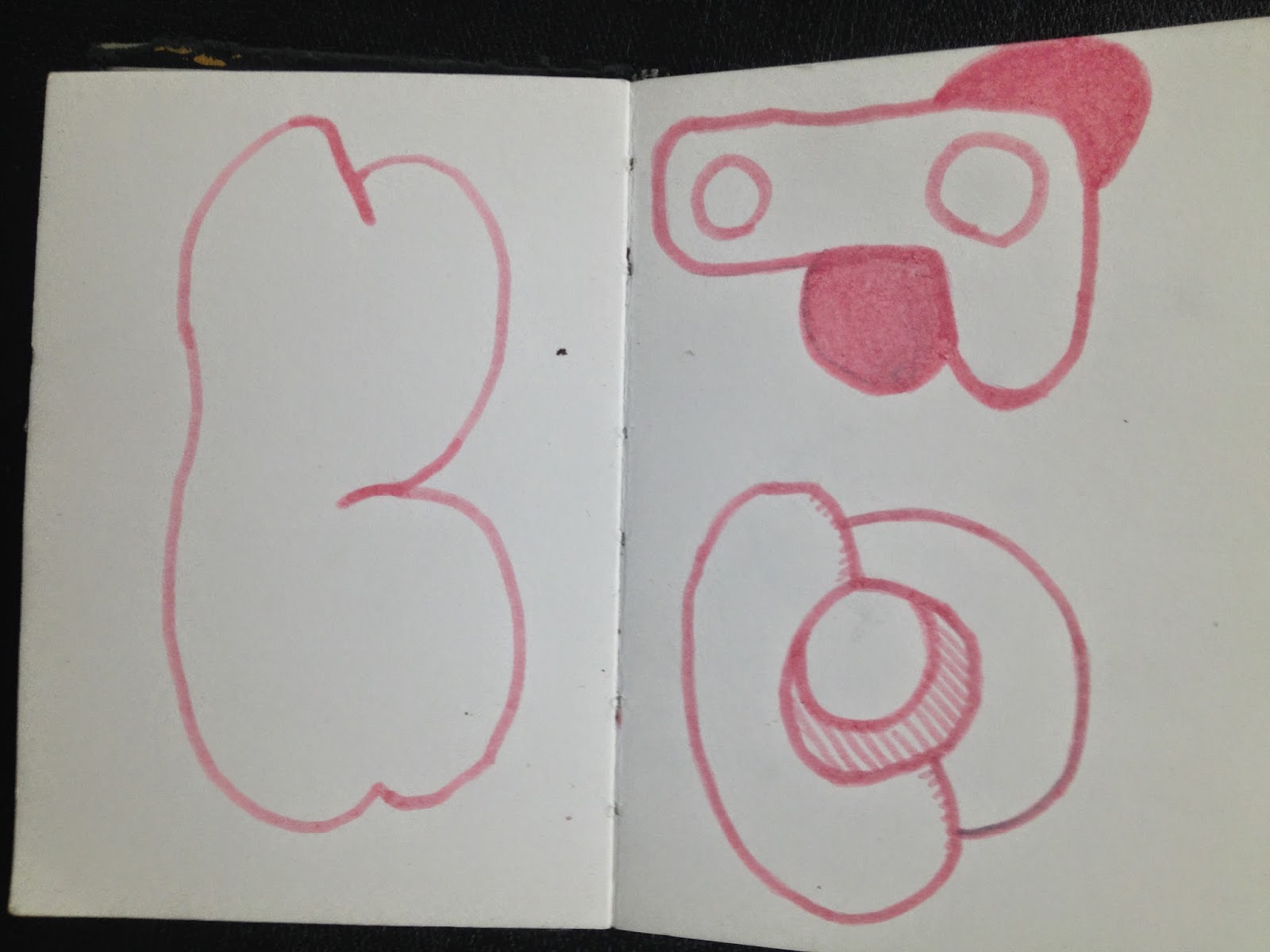
Below are a number of photographs taken from my sketchbooks. I drew these as free-form inspiration for, initially my paintings, but later for the collages and animations I have produced. You can see the resemblance to some of the pieces I have created.
My process was to create random curves, & connect these to the overall shape of the human body by adding in limbs at critical junctures.
Subscribe to:
Posts (Atom)